 11 Ekim 2026
- İstanbul25°C▼
- Ankara25°C





Air Passenger Numbers to Recover in 2024
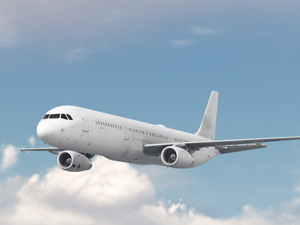
The International Air Transport Association (IATA) expects overall traveler numbers to reach 4.0 billion in 2024 (counting multi-sector connecting trips as one passenger), exceeding pre-COVID-19 levels (103% of the 2019 total).
01 Mart 2022 Salı 14:51
Expectations for the shape of the near-term recovery have shifted slightly, reflecting the evolution of government-imposed travel restrictions in some markets. The overall picture presented in the latest update to IATA’s long-term forecast, however, is unchanged from what was expected in November, prior to the Omicron variant.
“The trajectory for the recovery in passenger numbers from COVID-19 was not changed by the Omicron variant. People want to travel. And when travel restrictions are lifted, they return to the skies. There is still a long way to go to reach a normal state of affairs, but the forecast for the evolution in passenger numbers gives good reason to be optimistic,” said Willie Walsh, IATA’s Director General.
The February update to the long-term forecast includes the following highlights:
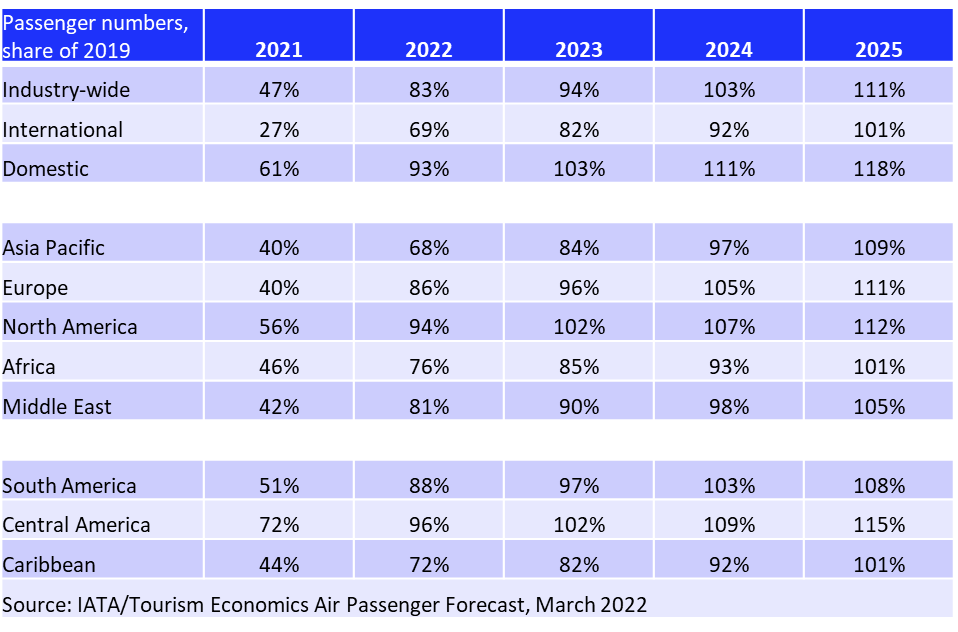
- In 2021, overall traveler numbers were 47% of 2019 levels. This is expected to improve to 83% in 2022, 94% in 2023, 103% in 2024 and 111% in 2025.
- In 2021, international traveler numbers were 27% of 2019 levels. This is expected to improve to 69% in 2022, 82% in 2023, 92% in 2024 and 101% in 2025.
This is a slightly more optimistic near-term international recovery scenario compared to November 2021, based on the progressive relaxation or elimination of travel restrictions in many markets. This has seen improvements in the major North Atlantic and intra-European markets, strengthening the baseline for recovery. Asia-Pacific is expected to continue to lag the recovery with the region’s largest market, China, not showing any signs of relaxing its severe border measures in the near future.
- In 2021, domestic traveler numbers were 61% of 2019 levels. This is expected to improve to 93% in 2022, 103% in 2023, 111% in 2024 and 118% in 2025.
The outlook for the evolution of domestic traveler numbers is slightly more pessimistic than in November. While the US and Russian domestic markets have recovered, the same is not true for the other major domestic markets of China, Canada, Japan and Australia.
“The biggest and most immediate drivers of passenger numbers are the restrictions that governments place on travel. Fortunately, more governments have understood that travel restrictions have little to no long-term impact on the spread of a virus. And the economic and social hardship caused for very limited benefit is simply no longer acceptable in a growing number of markets. As a result, the progressive removal of restrictions is giving a much-needed boost to the prospects for travel,” said Walsh.
IATA reiterates its call for:
- The removal of all travel barriers (including quarantine and testing) for those fully vaccinated with a WHO-approved vaccine
- Pre-departure antigen testing to enable quarantine-free travel for non-vaccinated travelers
- Removing all travel bans, and
- Accelerating the easing of travel restrictions in recognition that travelers pose no greater risk for COVID-19 spread than already exists in the general population.
Regional Variations
Not all markets or market sectors are recovering at the same pace.
“In general, we are moving in the right direction, but there are some concerns. Asia-Pacific is the laggard of the recovery. While Australia and New Zealand have announced measures to reconnect with the world, China is showing no signs of relaxing its zero-COVID strategy. The resulting localized lock-downs in its domestic market are depressing global passenger numbers even as other major markets like the US are largely back to normal,” said Walsh.
Asia-Pacific: The slow removal of international travel restrictions, and the likelihood of renewed domestic restrictions during COVID outbreaks, mean that traffic to/from/within Asia Pacific will only reach 68% of 2019 levels in 2022, the weakest outcome of the main regions. 2019 levels should be recovered in 2025 (109%) due to a slow recovery on international traffic in the region.
Europe: In the next few years, the intra-Europe market is expected to benefit from passenger preferences for short-haul travel as confidence rebuilds. This will be facilitated by increasingly harmonized and restriction-free movement within the EU. Total passenger numbers to/from/within Europe are expected to reach 86% of 2019 values in 2022, before making a full recovery in 2024 (105%).
North America: After a resilient 2021, traffic to/from/within North America will continue to perform strongly in 2022 as the US domestic market returns to pre-crisis trends, and with ongoing improvements in international travel. In 2022, passenger numbers will reach 94% of 2019 levels, and full recovery is expected in 2023 (102%), ahead of other regions.
Africa: Africa’s passenger traffic prospects are somewhat weaker in the near-term, due to slow progress in vaccinating the population, and the impact of the crisis on developing economies. Passenger numbers to/from/within Africa will recover more gradually than in other regions, reaching 76% of 2019 levels in 2022, surpassing pre-crisis levels only in 2025 (101%).
Middle East: With limited short-haul markets, the Middle East focus on long-haul connectivity through its hubs is expected to result in slower recovery. Passenger numbers to/from/within the Middle East are expected to reach 81% of 2019 levels in 2022, 98% in 2024 and 105% in 2025.
Latin America: Traffic to/from/within Latin America has been relatively resilient during the pandemic and is forecast to see a strong 2022, with limited travel restrictions and dynamic passenger flows within the region and to/from North America. 2019 passenger numbers are forecast to be surpassed in 2023 for Central America (102%), followed by South America in 2024 (103%) and the Caribbean in 2025 (101%).
 |
Russia-Ukraine Conflict
The forecast does not calculate the impact of the Russia-Ukraine conflict. In general, air transport is resilient against shocks and this conflict is unlikely to impact the long-term growth of air transport. It is too early to estimate what the near-term consequences will be for aviation, but it is clear that there are downside risks, in particular in markets with exposure to the conflict.
Sensitivity factors will include the geographic extent, severity, and time-period for sanctions and/or airspace closures. These impacts would be felt most severely in Russia, Ukraine and neighboring areas. Pre-COVID-19, Russia, was the 11th largest market for air transport services in terms of passenger numbers, including its large domestic market. Ukraine ranked 48.
The impact on airline costs as a result of fluctuations in energy prices or rerouting to avoid Russian airspace could have broader implications. Consumer confidence and economic activity are likely to be impacted even outside of Eastern Europe.
![UTİKAD Başkanı Bilgehan Engin: “Sektörümüzün Başarılarını Atlas Lojistik Ödülleri’nde Hep Birlikte Taçlandıralım”]() UTİKAD Başkanı Bilgehan Engin: “Sektörümüzün Başarılarını Atlas Lojistik Ödülleri’nde Hep Birlikte Taçlandıralım”2026 Atlas Lojistik Ödülleri’nde, 12 Ekim 2026’da sona erecek “Online Yarışma Kategorisi” adaylık süreci için açıklamalar yapan UTİKAD Başkanı Bilgehan Engin, “Tüm sektörümüzü aday olmaya ve başarılı buldukları adayları desteklemeye davet ediyoruz” dedi.09 Ekim 2026 Cuma 12:14Lojistik
UTİKAD Başkanı Bilgehan Engin: “Sektörümüzün Başarılarını Atlas Lojistik Ödülleri’nde Hep Birlikte Taçlandıralım”2026 Atlas Lojistik Ödülleri’nde, 12 Ekim 2026’da sona erecek “Online Yarışma Kategorisi” adaylık süreci için açıklamalar yapan UTİKAD Başkanı Bilgehan Engin, “Tüm sektörümüzü aday olmaya ve başarılı buldukları adayları desteklemeye davet ediyoruz” dedi.09 Ekim 2026 Cuma 12:14Lojistik![Prometeon’dan Devnak Filosuna Uçtan Uca Lastik ve Filo Yönetimi]() Prometeon’dan Devnak Filosuna Uçtan Uca Lastik ve Filo YönetimiPrometeon Türkiye, Devnak Nakliyat Grubu’nun 400 araçlık filosunda toplam 2.800 lastiği bulunan operasyonuna 360 derece lastik yönetimi sunacak.08 Ekim 2026 Perşembe 17:07Yan Sanayi
Prometeon’dan Devnak Filosuna Uçtan Uca Lastik ve Filo YönetimiPrometeon Türkiye, Devnak Nakliyat Grubu’nun 400 araçlık filosunda toplam 2.800 lastiği bulunan operasyonuna 360 derece lastik yönetimi sunacak.08 Ekim 2026 Perşembe 17:07Yan Sanayi![Iveco Türkiye’nin Yeni Ülke Müdürü Mehmet Karal Oldu]() Iveco Türkiye’nin Yeni Ülke Müdürü Mehmet Karal OlduOtomotiv sektöründe 20 yılı aşkın deneyime sahip Mehmet Karal, 28 Eylül 2026 itibarıyla Iveco Türkiye Ülke Müdürü olarak göreve başladı. Karal, markanın Türkiye’deki ticari operasyonları ve büyüme stratejisinden sorumlu olacak.07 Ekim 2026 Çarşamba 21:04Ticari Araçlar
Iveco Türkiye’nin Yeni Ülke Müdürü Mehmet Karal OlduOtomotiv sektöründe 20 yılı aşkın deneyime sahip Mehmet Karal, 28 Eylül 2026 itibarıyla Iveco Türkiye Ülke Müdürü olarak göreve başladı. Karal, markanın Türkiye’deki ticari operasyonları ve büyüme stratejisinden sorumlu olacak.07 Ekim 2026 Çarşamba 21:04Ticari Araçlar![Hyundai STARIA Cargo’da Hızlı Şarj ve Verimlilik Sunmayı Hedefliyor]() Hyundai STARIA Cargo’da Hızlı Şarj ve Verimlilik Sunmayı HedefliyorHyundai STARIA Cargo, 450 kilometreye varan elektrikli menzili ve 800 voltluk mimarisiyle yüzde 10’dan yüzde 80’e 20 dakikada şarj imkânı sunuyor.07 Ekim 2026 Çarşamba 20:46Ticari Araçlar
Hyundai STARIA Cargo’da Hızlı Şarj ve Verimlilik Sunmayı HedefliyorHyundai STARIA Cargo, 450 kilometreye varan elektrikli menzili ve 800 voltluk mimarisiyle yüzde 10’dan yüzde 80’e 20 dakikada şarj imkânı sunuyor.07 Ekim 2026 Çarşamba 20:46Ticari Araçlar![logitrans: Lojistik Sektörünün Radarındaki Küresel Buluşma]() logitrans: Lojistik Sektörünün Radarındaki Küresel Buluşma19. logitrans,15 ’den fazla ülkeden sektör profesyoneli, uluslararası markalar ve lojistik sektörünün tüm taşıma modlarını tek platformda buluşturmaya hazırlanıyor.07 Ekim 2026 Çarşamba 11:13Lojistik
logitrans: Lojistik Sektörünün Radarındaki Küresel Buluşma19. logitrans,15 ’den fazla ülkeden sektör profesyoneli, uluslararası markalar ve lojistik sektörünün tüm taşıma modlarını tek platformda buluşturmaya hazırlanıyor.07 Ekim 2026 Çarşamba 11:13Lojistik![Olmuştur: “Emniyet Tüm Faaliyetlerimizin Merkezinde”]() Olmuştur: “Emniyet Tüm Faaliyetlerimizin Merkezinde”THY Genel Müdürü Ahmet Olmuştur, havacılıkta teknoloji yatırımlarının insan deneyimi ve sağduyusuyla değer kazandığını belirterek güçlü emniyet kültüründe ortak sorumluluğa dikkat çekti.06 Ekim 2026 Salı 20:50Havayolu
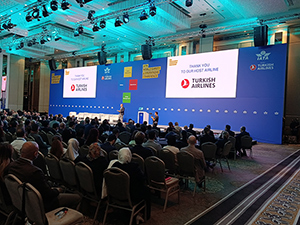
Olmuştur: “Emniyet Tüm Faaliyetlerimizin Merkezinde”THY Genel Müdürü Ahmet Olmuştur, havacılıkta teknoloji yatırımlarının insan deneyimi ve sağduyusuyla değer kazandığını belirterek güçlü emniyet kültüründe ortak sorumluluğa dikkat çekti.06 Ekim 2026 Salı 20:50Havayolu![IATA Havacılıkta Emniyet ve Güvenlik Konusunu İstanbul’da Konuşuyor. “İstanbul Dünyanın Önde Gelen Küresel Havacılık Merkezi”]() IATA Havacılıkta Emniyet ve Güvenlik Konusunu İstanbul’da Konuşuyor. “İstanbul Dünyanın Önde Gelen Küresel Havacılık Merkezi”#IATA #THY #havayolu06 Ekim 2026 Salı 20:42Havayolu
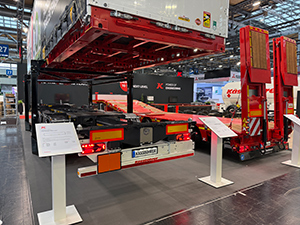
IATA Havacılıkta Emniyet ve Güvenlik Konusunu İstanbul’da Konuşuyor. “İstanbul Dünyanın Önde Gelen Küresel Havacılık Merkezi”#IATA #THY #havayolu06 Ekim 2026 Salı 20:42Havayolu![Tırsan’dan Verimlilik ve Güvenlik Odaklı Treyler Teknolojileri]() Tırsan’dan Verimlilik ve Güvenlik Odaklı Treyler TeknolojileriTırsan, IAA Transportation 2026’da sergilediği 15 araçla verimlilik, yük güvenliği, dayanıklılık ve elektrifikasyon alanlarındaki çözümlerini sektör temsilcileriyle buluşturdu.06 Ekim 2026 Salı 18:36Ticari Araçlar
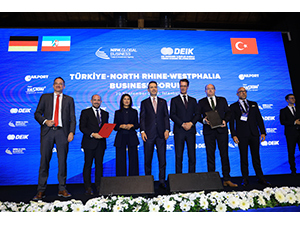
Tırsan’dan Verimlilik ve Güvenlik Odaklı Treyler TeknolojileriTırsan, IAA Transportation 2026’da sergilediği 15 araçla verimlilik, yük güvenliği, dayanıklılık ve elektrifikasyon alanlarındaki çözümlerini sektör temsilcileriyle buluşturdu.06 Ekim 2026 Salı 18:36Ticari Araçlar![Railport’tan Türkiye–NRW Lojistik Bağlantılarına Destek]() Railport’tan Türkiye–NRW Lojistik Bağlantılarına DestekRailport’un desteklediği Türkiye–Kuzey Ren-Vestfalya (NRW) İş Forumu’nda, ticaret ve yatırım ilişkilerinin geliştirilmesinde intermodal bağlantıların ve ulaşım koridorlarının rolü ele alındı.02 Ekim 2026 Cuma 19:20Lojistik
Railport’tan Türkiye–NRW Lojistik Bağlantılarına DestekRailport’un desteklediği Türkiye–Kuzey Ren-Vestfalya (NRW) İş Forumu’nda, ticaret ve yatırım ilişkilerinin geliştirilmesinde intermodal bağlantıların ve ulaşım koridorlarının rolü ele alındı.02 Ekim 2026 Cuma 19:20Lojistik![InnoTrans 2026 Highlights the Future of Rail Mobility]() InnoTrans 2026 Highlights the Future of Rail MobilityInnoTrans 2026 marked its 30th anniversary with record participation, bringing together 175,591 trade visitors and 3,190 exhibitors in Berlin.02 Ekim 2026 Cuma 19:06World News
InnoTrans 2026 Highlights the Future of Rail MobilityInnoTrans 2026 marked its 30th anniversary with record participation, bringing together 175,591 trade visitors and 3,190 exhibitors in Berlin.02 Ekim 2026 Cuma 19:06World News











- Geri
- Ana Sayfa
- Normal Görünüm
- © 2026 Kargo Haber
Türkçe karakter kullanılmayan ve büyük harflerle yazılmış yorumlar onaylanmamaktadır.